
* All product/brand names, logos, and trademarks are property of their respective owners.
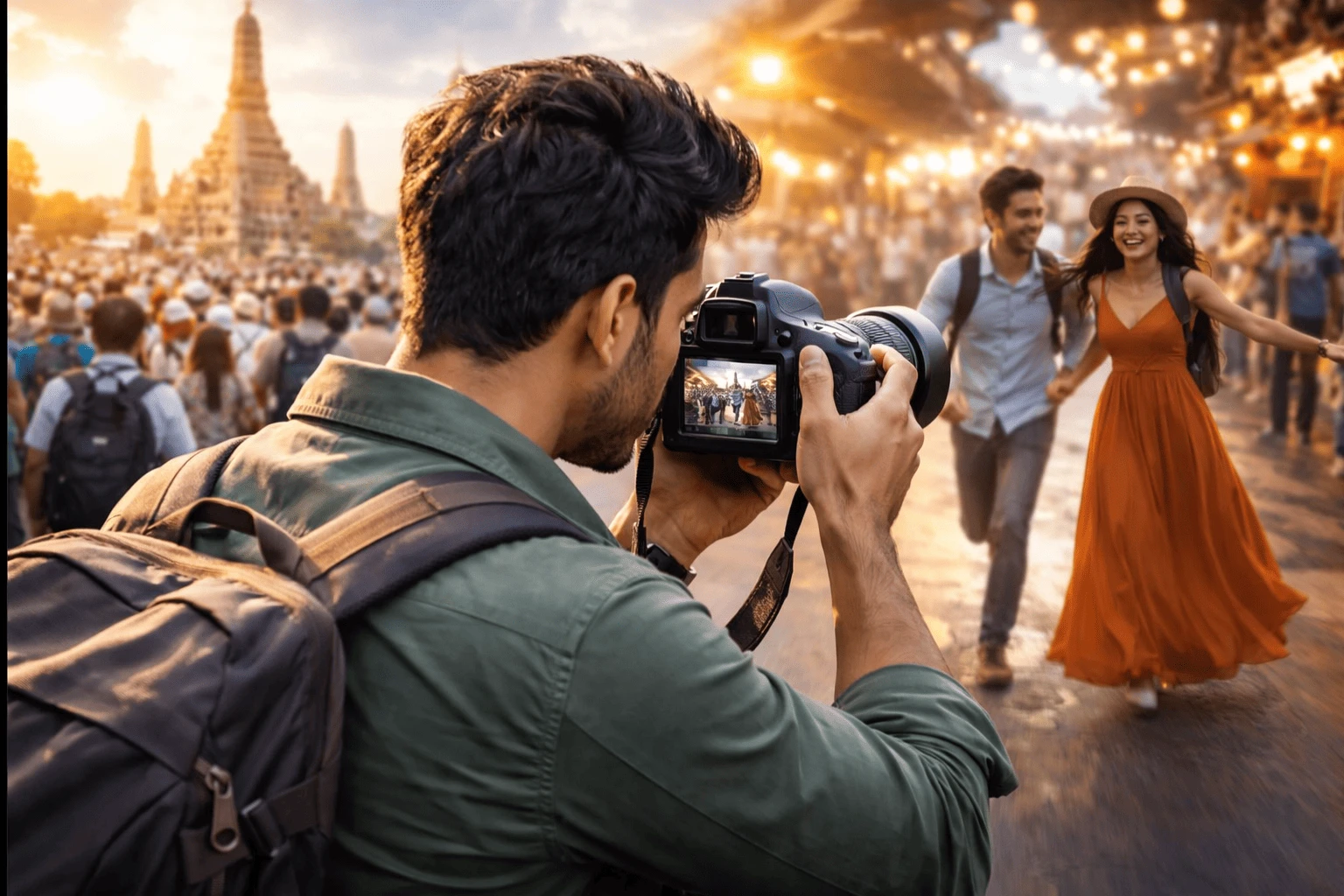
Great travel photos don’t just happen in perfect conditions. Most of the time, you’re dealing with harsh sunlight, crowded places, limited time, or just your phone in hand. That’s what makes travel photography tricky—and also exciting.
The good news? You don’t need expensive gear or ideal locations to capture beautiful shots. With the right approach, you can take stunning photos almost anywhere—whether you’re exploring a busy street, hiking in the mountains, or waiting at an airport.
Light can make an average travel photo look beautiful—or make a great scene fall flat. The key is not waiting for perfect light every time. It’s learning how to use whatever light you have.
When the light looks bad, most people blame the location. In reality, small changes in position can completely improve the shot.
Try these simple adjustments:
A good habit is to pause for a few seconds before shooting and ask: where is the light coming from? That quick check often makes a huge difference.
Midday sun is one of the hardest things in travel photography. It creates bright highlights, dark shadows, and unflattering faces. But you can still get great shots.
Here’s what helps:
If you are in a famous tourist spot at noon, it may be smarter to focus on colors, shapes, and local details rather than forcing a portrait in bad light.
Travel does not stop at sunset, and some of the most memorable scenes happen at night. Markets, city streets, cafés, and landmarks can look amazing in low light if you keep your camera steady.
A few practical tips:
Night photos do not always need to be perfectly bright. Sometimes a darker, moodier image feels more natural and tells the story better.
Good composition helps you turn an ordinary travel scene into a photo that feels more intentional. You do not need to memorize complex rules. A few simple techniques can improve your shots right away.
This is one of the easiest ways to make a photo look more balanced. Instead of placing your subject directly in the center every time, imagine the frame divided into nine equal parts.
Try this in practice:
Most phones let you turn on gridlines, which makes this much easier while shooting.
Leading lines guide the viewer’s eye through the image. They add depth and make photos feel more dynamic.
Common travel examples include:
If you spot a strong line in the scene, use it to pull attention toward your subject or the background view.
Framing means using elements in the scene to surround or highlight your subject. This adds focus without making the image feel forced.
You can use:
For example, instead of photographing a building straight on, try shooting it through an arch or between nearby objects to create more depth.
A strong subject can still get lost in a messy frame. Before taking the shot, quickly check what is behind your subject.
Ask yourself:
Even a small shift in angle can make the photo look much cleaner.
Not every travel photo needs a wide landscape view. Sometimes the best shot is a close-up of something small and specific.
This works well for:
These kinds of images help tell the full story of a trip and add variety to your photo collection.
You don’t need a high-end camera to take great travel photos. What matters more is how you use the device you already have. Whether you’re shooting on a smartphone or a DSLR, a few simple adjustments can make a big difference.
Phones are powerful, but most people only use them in auto mode without thinking about control. Small habits can instantly improve your results.
If you take a second to set up the shot instead of snapping quickly, your phone photos will look much more intentional.
If you’re using a DSLR or mirrorless camera, you don’t need to master everything. Just understanding three basics gives you much more control:
ISO → controls brightness
Shutter Speed → controls motion
Aperture → controls background blur
You don’t need to adjust all three every time. Start by changing one setting based on the situation, and you’ll quickly get more comfortable.
No matter what you’re using:
It’s easy to take good photos when everything is perfect. The real skill shows when conditions aren’t ideal—crowds, movement, limited time, or average locations. These situations are common while traveling, so knowing how to handle them makes a big difference.
Busy locations can feel frustrating, but you don’t always need an empty scene to get a great shot.
Try this instead:
Sometimes a photo with motion and people tells a better story than an empty landmark.
Travel doesn’t always give you time to plan every shot. You might be walking, in a vehicle, or catching something quickly.
To stay ready:
A slightly imperfect photo is better than missing the moment completely.
Want to truly capture road trip moments? Don’t miss this article: The Journey Was Better Than the Destination
Not every location will feel “Instagram-worthy,” but that doesn’t mean you can’t create something unique.
Look for:
Instead of trying to capture everything, zoom in on what makes that place different. A simple street corner can become a strong photo if you notice the right detail.
Even with the right tips, a few common mistakes can hold your photos back. Being aware of these can instantly improve your results.
Great travel photos aren’t about having the perfect camera or being in the perfect place. What really matters is how you see the scene and how you use the tools you already have.
By understanding light, improving your composition, and adapting to real-world situations, you can take stunning photos anywhere. Whether you’re using a smartphone or a camera, these travel photography tips are all about making the most of every moment.
The next time you travel, slow down for a second, look around, and apply even a few of these techniques—you’ll start to notice a real difference in your photos.
Looking for family-friendly travel ideas? Check out: Best Travel Destinations for Families in Pakistan

I am Zeenat, an SEO Specialist and Content Writer specializing in on-page and off-page SEO to improve website visibility, user experience, and performance.
I optimize website content, meta elements, and site structure, and implement effective off-page SEO strategies, including link building and authority development. Through keyword research and performance analysis, I drive targeted organic traffic and improve search rankings.
I create high-quality, search-optimized content using data-driven, white-hat SEO practices, focused on delivering sustainable, long-term growth and improved online visibility.
Be the first to share your thoughts
No comments yet. Be the first to comment!
Share your thoughts and join the discussion below.


